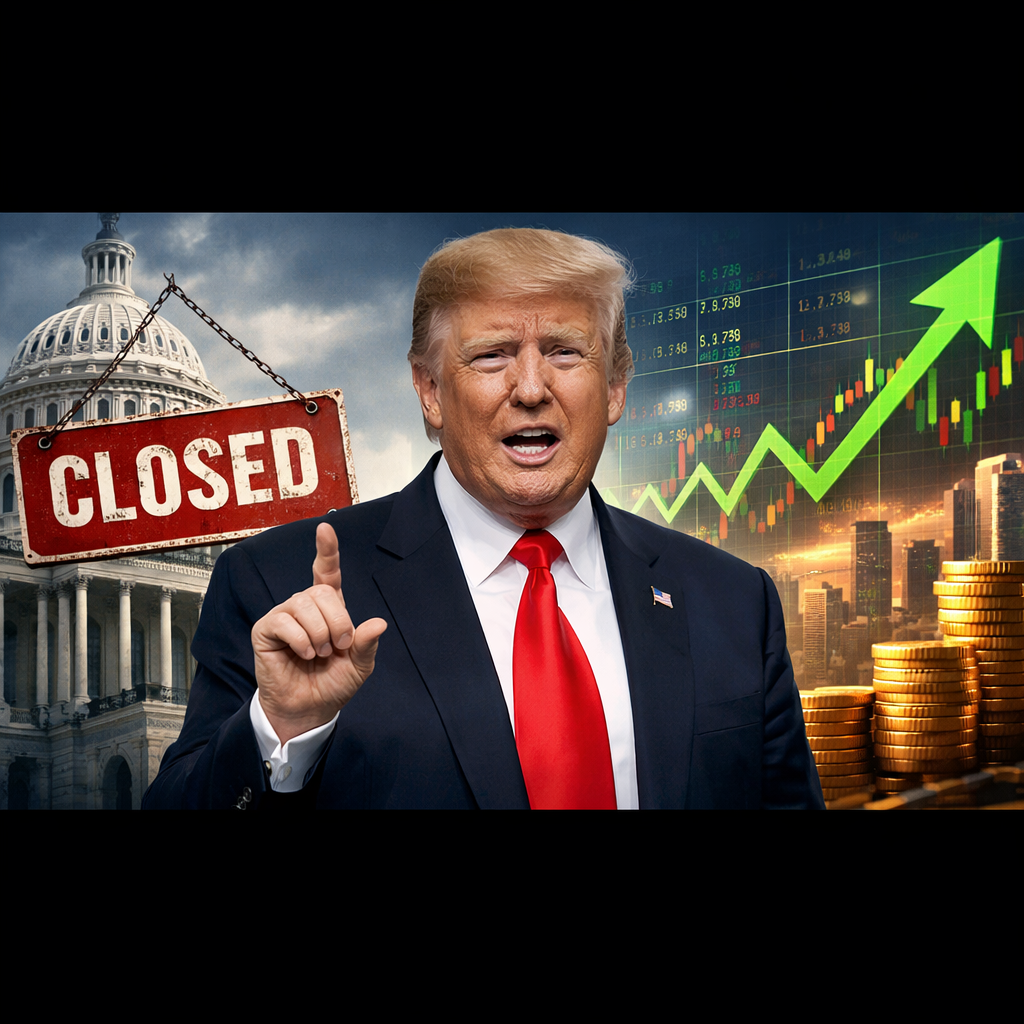
Markets Move Ahead of the Headlines
Markets don’t wait for political clarity. That’s one of the first lessons investors learn—and one of the hardest to accept in real time. While headlines scream about the longest government shutdown in U.S. history, stocks have continued to grind higher. Add in bold statements like “the rally is just beginning,” and you’ve got the perfect recipe for confusion, overconfidence, or hesitation.
This article breaks down what’s really happening beneath the surface. We’ll look at how markets behave during political disruptions, why shutdowns don’t always derail equities, and how experienced investors think about risk when optimism gets loud. You’ll also get a practical look at positioning strategies—how to stay invested without getting reckless.
Because in uncertain times, discipline matters more than predictions.
Why Markets Can Rise During Political Disruption
At first glance, it feels irrational. A historic government shutdown is underway, hundreds of thousands of federal employees are unpaid, and key services—from airport operations to regulatory functions—are strained. Yet the stock market continues to rise. What gives?
The answer lies in how markets process information. Markets are forward-looking, not reactive to current discomfort alone. Investors are constantly pricing in expectations about the future—economic growth, corporate earnings, interest rates, and policy resolution.
A shutdown, while disruptive, is often viewed as temporary. Historically, most shutdowns have been resolved without long-term economic damage. That expectation softens the market’s reaction.
There’s also a lag effect. As noted in discussions among observers, the real economic pain takes time to show up. Government workers may initially continue working without pay, expecting back compensation. But as the shutdown drags on, financial strain builds—missed bills, rising debt, reduced spending. Those second-order effects can eventually ripple through the economy.
For example, if air traffic controllers or TSA agents begin missing shifts due to financial pressure, travel disruptions follow. That impacts airlines, tourism, and broader business activity. These are not immediate shocks—they build gradually.
This delay is exactly why markets can appear calm—or even optimistic—early in a crisis.
Suggested visual: A timeline chart showing delayed economic effects of a shutdown (immediate vs. lagging impacts).
The Risk Behind Confident Narratives
Statements like “the rally is just beginning” are powerful. They tap into a deep psychological driver in markets: fear of missing out. When investors hear confident bullish predictions, especially from high-profile figures, it can create a sense of urgency.
But seasoned investors often react differently.
Instead of leaning in, they tighten risk.
Why? Because extreme confidence—especially during uncertain conditions—is often a signal to stay cautious. Markets rarely move in straight lines, and strong narratives can lead to crowded positioning. When too many participants are leaning the same way, even a small negative surprise can trigger sharp corrections.
Think of it this way: markets don’t punish doubt—they punish complacency.
An investor with 16 years of experience might hear “this is just the beginning” and interpret it not as a green light, but as a reminder to review exposure, reassess downside risk, and prepare for volatility.
This doesn’t mean becoming pessimistic. It means staying grounded.
Suggested visual: Sentiment indicator chart showing peaks in optimism vs. subsequent market pullbacks.
Balancing Exposure with Strategy and Positioning
So what does “staying rational” actually look like in a market like this? It’s less about making bold moves and more about maintaining balance.
A conservative strategy in this context typically includes three key elements.
First, keeping long positions intact. If your core investments are based on solid fundamentals—strong companies, diversified exposure, long-term growth trends—there’s usually no need to exit simply בגלל political noise. Selling purely out of fear often leads to missed recoveries.
Second, adding small hedges. This could mean allocating a portion of the portfolio to assets that tend to perform well during downturns, such as defensive sectors, bonds, or even options strategies. The goal isn’t to eliminate risk entirely—it’s to reduce the impact of adverse moves.
Third, maintaining liquidity. Holding cash may feel unproductive during a rising market, but it provides flexibility. If a correction occurs, cash allows you to buy assets at more attractive valuations without needing to sell existing positions at a loss.
This approach reflects a mindset shift: from trying to predict the market to preparing for multiple outcomes.
Suggested visual: Portfolio allocation pie chart showing core positions, hedges, and cash reserves.
Position sizing is one of the most underappreciated tools in investing. It’s not just about what you buy—it’s about how much you allocate to each idea.
In uncertain environments, smart position sizing can make the difference between staying in the game and being forced out.
Here’s a simple framework to think about it:
Start with conviction. High-conviction ideas—based on strong fundamentals and long-term trends—can justify larger positions. Lower-conviction trades should be smaller by default.
Adjust for volatility. If an asset or sector is experiencing increased volatility due to macro uncertainty, consider reducing position size even if your long-term view hasn’t changed.
Account for correlation. If multiple positions are likely to move together (for example, tech stocks during a growth rally), your effective exposure may be larger than it թվում. Diversification isn’t just about the number of positions—it’s about how they behave relative to each other.
Leave room to act. Avoid being fully deployed. Keeping some capital in reserve allows you to respond to opportunities instead of being a passive observer.
This approach aligns with the idea of staying “neither pessimistic nor blindly optimistic.” It’s about managing risk while remaining open to upside.
Suggested visual: Example table comparing aggressive vs. conservative position sizing under different market conditions.
The Human Impact and Practical Investor Response
It’s easy to treat shutdowns as abstract political events, but they have real human consequences—and those consequences eventually feed back into markets.
Federal employees, including critical roles like air traffic controllers and security personnel, often continue working without pay during shutdowns. While many expect back pay, the financial strain is real. Missed paychecks can lead to debt accumulation, delayed payments, and reduced consumer spending.
There’s also a legal dimension. Federal employees are generally prohibited from striking, which means they can’t simply stop working en masse to force a resolution. This keeps systems running longer than they otherwise might—but it also prolongs the underlying stress.
Over time, cracks can appear. Workers may call in sick, seek alternative income, or reduce discretionary spending. These behavioral shifts can ripple outward, affecting industries from retail to travel.
For investors, the key takeaway is that macro events have layers. The first layer is headlines. The second is economic data. The third—and often most important—is human behavior.
Understanding all three helps you anticipate how situations evolve, rather than reacting to surface-level narratives.
If you’re feeling uncertain, that’s normal. Markets during political tension can feel contradictory. Here are some grounded ways to approach it:
Focus on process over predictions. You don’t need to know what will happen next—you need a plan for different scenarios.
Revisit your risk tolerance. If a sudden 10–15% drop would force you to sell, your current exposure may be too high.
Avoid reacting to single headlines. Political statements, even from influential figures, often reflect positioning rather than certainty.
Use volatility to your advantage. Gradual buying during dips can be more effective than trying to time a bottom.
Track real-world signals. Watch indicators like consumer spending, employment trends, and corporate guidance—not just market prices.
Stay diversified. Concentration can amplify gains, but it also increases vulnerability during unexpected shifts.
Suggested formatting: This section could be presented as a bullet list or checklist for quick reference.
Markets don’t reward the loudest voices—they reward disciplined behavior over time. A government shutdown, even a historic one, doesn’t automatically dictate market direction. Nor do confident predictions guarantee continued gains.
What matters is how you respond.
Staying invested while managing risk, maintaining liquidity, and sizing positions thoughtfully is not a sign of indecision—it’s a strategy. It allows you to participate in upside while remaining resilient to downside.
In moments like this, the goal isn’t to be right about the next move. It’s to be prepared for whatever comes next.
Because in investing, survival and consistency matter more than short-term certainty.
References and Further Reading
For those who want to explore deeper, consider the following منابع:
U.S. Congressional Research Service reports on government shutdowns and their economic impact.
Historical market performance data during past shutdowns (Federal Reserve Economic Data - FRED).
Behavioral finance books such as “Thinking, Fast and Slow” by Daniel Kahneman.
Investment strategy frameworks from firms like Vanguard, BlackRock, and Morgan Stanley.
These resources can provide additional context and help you build a more robust investment approach grounded in both data and psychology.